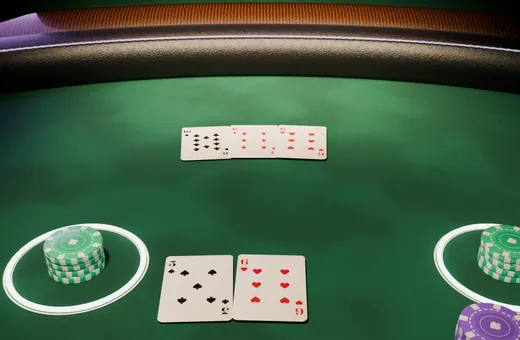
The rules below follow the rules of play published by the Washington State Gambling Commission, the Pennsylvania Gaming Control Board (58 Pa. Code Chapter 672a) and the Nevada Gaming Control Board. Where they disagree, the difference is stated and the jurisdiction table further down collects them in one place. The short answer to how does free bet blackjack work: it is regular blackjack with two house-paid offers and one dealer result that returns your bet. If you are new and wondering how does free bet blackjack work in practice, the round below goes from the deal to the payout.
How does free bet blackjack work? A round from deal to payout#
Here is how free bet blackjack works, in order.
- You place your starting bet. This is the only chip you are required to stake.
- You and the dealer are dealt two cards each, one of the dealer's cards face up. The dealer checks the hole card for blackjack when the up-card is an ace or a ten-value card.
- If you hold a blackjack, it pays 3 to 2 before the dealer plays, and a dealer 22 cannot touch it.
- If your first two cards are a hard 9, 10 or 11, or a pair that qualifies, the house offers the free bet. You take it or play on as usual.
- You finish your hands. Any hand over 21 loses at once, free lammer or not.
- The dealer plays out. The dealer draws to 16 and stands on 17. The one open question is a soft 17, which the jurisdictions treat differently.
- Hands are settled against the dealer's total. A dealer 22 pushes everything still standing.
That covers how to play free bet blackjack: the decisions are the ones you know, with two extra offers and one extra dealer result. There is no surrender. Insurance pays 2 to 1, as in regular blackjack.
Free doubles: which hands qualify#
A free double is available on a hard 9, 10 or 11 made of your first two cards. "Hard" means no ace counted as 11. A five and a four is a hard 9, so is a six and a three. An ace and a six is not, whatever it adds up to.
You may also double after a split, and the double is still free if the two-card hand is a hard 9, 10 or 11. On any other total you can still double, but you must add a stake equal to your bet, exactly as in regular blackjack. Washington's rules allow paid doubles on two-card hands only. The Nevada document lets you double on any number of cards, and lets the free double apply to a hard 9, 10 or 11 however many cards make it.
Free splits: which pairs qualify#
Every pair splits for free except ten-value cards. That includes aces, eights, fives and the small pairs. A pair of ten-value cards (ten, jack, queen or king) may still be split, but you pay a stake equal to your original bet for the second hand. That is the Pennsylvania wording.
You can re-split pairs for free up to four hands. Nevada's document differs in one place: it excludes fours from the free split. A pair of fours is then split at your own cost, if at all.
When you split for free, your original bet moves onto the first hand, and the house lammer sits on the second. Aces are the loose end. Nevada says aces may be re-split and each receives one additional card. The Washington and Pennsylvania texts state no ace restriction at all, so we show that as an open point rather than guessing.
What happens if you win with a free bet?#
The house pays what a real bet would win. A free double that wins is worth twice your starting bet, for the price of one. A free double that loses costs you the starting bet only, because the house's lammer is simply removed.
| Outcome for a free-doubled hand | You receive | You lose |
|---|
| Hand wins | Winnings on both stakes (twice your bet) | Nothing |
| Hand loses | Nothing | Your starting bet only |
| Hand ties the dealer | Your bet back, house lammer removed | Nothing |
| Dealer finishes on 22 | Your bet back, house lammer removed | Nothing |
| You bust | Nothing | Your starting bet only |
Four worked hands#
A free double that wins. You hold a six and a five (hard 11) against a dealer six. You take the free double and draw a nine, finishing on twenty. The dealer turns over a ten under the six, draws a three, and stops on nineteen. You win twice your starting bet, and you never staked more than the starting bet.
The same hand, with a dealer 22. Start again from the six and five and the drawn nine, on twenty. This time the dealer's hole card is a ten, giving sixteen, and the next card is a six. That makes 22. In regular blackjack you would have won on a doubled bet. Here the hand is a push: your starting bet returns, the house lammer is removed, and you are exactly where you were before the deal.
A free double that loses. You hold a five and a four (hard 9) against a dealer ten. The free double is still the right play. You draw a two for 11, the dealer shows eighteen, and you lose. You lose the starting bet, not twice it.
A free split. You hold two eights against a dealer nine. You split for free: one eight stays with your bet, the other with the house lammer. You get a three on the first eight (hard 11, another free double) and play on. Two hands are in play for the price of one bet.