Perfect Pairs Blackjack Side Bet: Pay Tables, Odds and House Edge
Perfect Pairs is a blackjack side bet on your first two cards only. It pays when they are a pair of the same rank, and it pays more when the pair also matches in colour or in suit. Regulator documents in Pennsylvania, Nevada and New South Wales print four pay tables that have a published figure, from 2.17% (House edge, lowest of the published versions of Perfect Pairs, every documented pay table: 25 / 15 / 5, 8 decks. Exact count over a fresh shoe.) to 10.63% (House edge, highest of the published versions of Perfect Pairs, every documented pay table: 30 / 10 / 5, 4 decks. Exact count over a fresh shoe.) in house edge, and several more that are listed but carry no figure here. The bet is settled at the deal, so it never touches the way you play the main hand. This page shows every table, the exact odds of each kind of pair and how the deck count moves the price.
At a glance
How the Bet Is Settled and What It Pays
- Game
- Blackjack, and Pontoon on 48-card decks
- Cards that count
- Your first two cards
- Settled
- Right after the deal, before anyone acts
- Pay tables in regulator documents
- 4, and 12 more with no figure
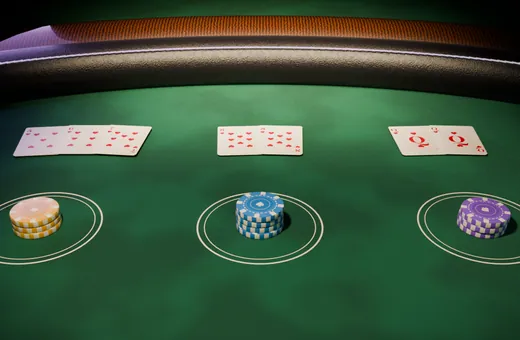
The bet wins when your first two cards are a pair of the same rank. A perfect pair is the same rank and suit, a coloured pair is the same rank and colour in another suit, and a mixed pair is the same rank in a different colour.
Base pay table 25 / 12 / 6, PA 633c.1 A, NV A, NV live
- Perfect pair
- 25 to 1
- Coloured pair
- 12 to 1
- Mixed pair
- 6 to 1
House edge 6.11% at 6 decks.
How the Perfect Pairs Blackjack Side Bet Works
The wager goes in its own spot before the cards are dealt. When your first two cards are face up, the bet is decided by them alone. The dealer's cards, the third card of a hit and the outcome of the main hand are not part of it.
A pair means two cards of the same rank, so a king and a queen are not a pair, and a king and a ten are not either. Three kinds of pair pay. A perfect pair is the same rank and the same suit, which needs at least two decks because a single deck holds only one of each card. A coloured pair is the same rank and the same colour in a different suit, such as the king of hearts with the king of diamonds. A mixed pair is the same rank in different colours, such as the king of hearts with the king of spades. Only the highest kind pays.
The same bet is offered in Pontoon on 48-card decks. Those decks have the four pip tens removed from every deck, while jacks, queens and kings stay, and the rest of the rules are the same. The Star Sydney rules and the Crown Melbourne pairs table are the regulator documents behind that version.
Perfect Pairs Pay Tables From Regulator Documents
Four tables have a published figure. All four pay for the same three kinds of pair, and only the multiples differ.
- The 25 / 12 / 6 table, printed as Pennsylvania 58 Pa. Code 633c.1 table A, Nevada table A and the Nevada live-dealer rules, pays 25 to 1 for a perfect pair, 12 to 1 for a coloured pair and 6 to 1 for a mixed pair.
- The 30 / 10 / 5 table, Pennsylvania table B and Nevada table B, pays 30 to 1, 10 to 1 and 5 to 1.
- The 25 / 15 / 5 table, Nevada table D, pays 25 to 1, 15 to 1 and 5 to 1.
- The 25 / 10 / 5 table for 48-card decks, from the Star Sydney rules and the Crown Melbourne pairs table, pays 25 to 1, 10 to 1 and 5 to 1.
Other tables are documented and shown with no figure. They are Nevada table C, the Canberra Pontoon approval on 48-card decks and the Crown Melbourne options for four to eight decks. For each, the printed pays have not been confirmed against the document, so the pays and the house edge are left out rather than guessed. The compare block further down lists them with the reason.
Explorer
Pick a Pay Table and a Deck Count
Scale from zero to 30 percent. Green tick: the main game at 0.62%, six decks, dealer hits soft 17.
-
1 Perfect Pairs Blackjack, and Pontoon on 48-card decks 2.17% to 10.63% 4 pay tables
The bet wins when your first two cards are a pair of the same rank. A perfect pair is the same rank and suit, a coloured pair is the same rank and colour in another suit, and a mixed pair is the same rank in a different colour.
-
25 / 15 / 5 4.18% at 6 decks 4 to 8 decks
- Perfect pair
- 25 to 1
- Coloured pair
- 15 to 1
- Mixed pair
- 5 to 1
Regulator text: NV D
House edge 8.21% Chance of a win 7.25%
Computed exactly: every card combination of the stated shoe is counted without replacement.
House edge 5.79% Chance of a win 7.34%
Computed exactly: every card combination of the stated shoe is counted without replacement.
House edge 4.18% Chance of a win 7.40%
Computed exactly: every card combination of the stated shoe is counted without replacement.
House edge 2.17% Chance of a win 7.47%
Computed exactly: every card combination of the stated shoe is counted without replacement.
-
30 / 10 / 5 5.79% at 6 decks 4 to 8 decks
- Perfect pair
- 30 to 1
- Coloured pair
- 10 to 1
- Mixed pair
- 5 to 1
Regulator text: PA 633c.1 B, NV B
The outcome table for each deck count (every hand, what it pays, how often it comes) loads when you open this pay table, and needs scripts to do so. The house edge at the reference rules is above.
-
25 / 12 / 6 6.11% at 6 decks 4 to 8 decks
- Perfect pair
- 25 to 1
- Coloured pair
- 12 to 1
- Mixed pair
- 6 to 1
Regulator text: PA 633c.1 A, NV A, NV live
The outcome table for each deck count (every hand, what it pays, how often it comes) loads when you open this pay table, and needs scripts to do so. The house edge at the reference rules is above.
-
25 / 10 / 5 6.62% at 6 decks 6 to 8 decks
- Perfect pair
- 25 to 1
- Coloured pair
- 10 to 1
- Mixed pair
- 5 to 1
Regulator text: Star rule 15.8, Crown Pairs table Pontoon columns . 48-card decks, no tens
The outcome table for each deck count (every hand, what it pays, how often it comes) loads when you open this pay table, and needs scripts to do so. The house edge at the reference rules is above.
-
No side bet has that many pay table versions.
Bar length is on a log scale, from 1 in a million to certain, so rare awards stay visible.
What Each Perfect Pairs Pay Table Costs in House Edge
The house edge of a side bet is the average loss as a share of the side bet itself. It is one minus the average return, where each paying pair returns the stake plus its pay. The multiples decide it, and the deck count changes it as much.
At six decks the 25 / 12 / 6 table costs 6.11% (House edge, Perfect Pairs, pay table 25 / 12 / 6, 6 decks. Exact count over a fresh, randomly shuffled shoe.), the 30 / 10 / 5 table 5.79% (House edge, Perfect Pairs, pay table 30 / 10 / 5, 6 decks. Exact count over a fresh, randomly shuffled shoe.), and the 25 / 15 / 5 table 4.18% (House edge, Perfect Pairs, pay table 25 / 15 / 5, 6 decks. Exact count over a fresh, randomly shuffled shoe.). The 25 / 15 / 5 table is the cheapest at every deck count. Its 15 to 1 pay for the coloured pair lands on a hand that comes up more often than the rare perfect pair, so it returns more than the top pay of the other tables does. The 48-card table costs 6.62% (House edge, Perfect Pairs, pay table 25 / 10 / 5, 6 decks. Exact count over a fresh, randomly shuffled shoe.) at six decks.
The ranking of two tables can flip when the shoe changes. At four decks the 30 / 10 / 5 table costs 10.63% (House edge, Perfect Pairs, pay table 30 / 10 / 5, 4 decks. Exact count over a fresh, randomly shuffled shoe.) against 10.14% (House edge, Perfect Pairs, pay table 25 / 12 / 6, 4 decks. Exact count over a fresh, randomly shuffled shoe.) for the 25 / 12 / 6 table. At eight decks the order reverses, with 3.37% (House edge, Perfect Pairs, pay table 30 / 10 / 5, 8 decks. Exact count over a fresh, randomly shuffled shoe.) against 4.10% (House edge, Perfect Pairs, pay table 25 / 12 / 6, 8 decks. Exact count over a fresh, randomly shuffled shoe.). A higher top pay is worth more when more decks make perfect pairs more frequent, so the table with the bigger top award gains ground as decks are added.
For comparison, the main game under the comparison rules used on this site costs 0.62% (Comparison rules: 6 decks, dealer hits soft 17, double after split, blackjack pays 3:2. House edge per starting bet: the average loss per round as a share of the bet placed before the cards are dealt, doubles and splits included in the result. Rules: 6 decks, dealer hits soft 17, dealer checks for blackjack with a hole card, blackjack pays 3:2, double on any first two cards, double after split, split up to 4 hands, aces are not resplit, one card to each split ace, no surrender. The player follows the printed strategy chart for these rules from a full shoe, and never takes insurance or even money.). Every Perfect Pairs table costs a multiple of that.
Side by side
Compare the Pay Tables
-
- Perfect pair
- 25 to 1
- Coloured pair
- 15 to 1
- Mixed pair
- 5 to 1
2.17% to 8.21%Reference: 6 decks
-
- Perfect pair
- 30 to 1
- Coloured pair
- 10 to 1
- Mixed pair
- 5 to 1
3.37% to 10.63%Reference: 6 decks
-
- Perfect pair
- 25 to 1
- Coloured pair
- 12 to 1
- Mixed pair
- 6 to 1
4.10% to 10.14%Reference: 6 decks
-
- Perfect pair
- 25 to 1
- Coloured pair
- 10 to 1
- Mixed pair
- 5 to 1
4.44% to 6.62%Reference: 6 decks
Scale from zero to 30 percent. The green tick is the main game at 0.62%, six decks, dealer hits soft 17. Ranked by the house edge at the reference deck count.
House edge by pay table and deck count
| Pay table | 4 decks | 5 decks | 6 decks | 8 decks |
|---|---|---|---|---|
| 25 / 15 / 5 | 8.21% | 5.79% | 4.18% | 2.17% |
| 30 / 10 / 5 | 10.63% | 7.72% | 5.79% | 3.37% |
| 25 / 12 / 6 | 10.14% | 7.72% | 6.11% | 4.10% |
| 25 / 10 / 5 | not documented | not documented | 6.62% | 4.44% |
Cell shading follows the size of the edge within this table set, from the lowest, 2.17%, to the highest, 10.63%.
Documented tables with no figure
- Nevada rules, pay table CNo figureThe table is documented, but its printed pays are still to be confirmed against the source document.
- Canberra Pontoon approval, 48-card decksNo figureThe table is documented, but its current version is still to be confirmed with the regulator.
- Crown Pairs 4 decks option ANo figureThe table is listed in the approved rules; the rows have not yet been read back against the document.
- Crown Pairs 4 decks option BNo figureThe table is listed in the approved rules; the rows have not yet been read back against the document.
- Crown Pairs 4 decks option CNo figureThe table is listed in the approved rules; the rows have not yet been read back against the document.
- Crown Pairs 5 decksNo figureThe table is listed in the approved rules; the rows have not yet been read back against the document.
- Crown Pairs 6 decks option ANo figureThe table is listed in the approved rules; the rows have not yet been read back against the document.
- Crown Pairs 6 decks option BNo figureThe table is listed in the approved rules; the rows have not yet been read back against the document.
- Crown Pairs 6 decks option CNo figureThe table is listed in the approved rules; the rows have not yet been read back against the document.
- Crown Pairs 7 decksNo figureThe table is listed in the approved rules; the rows have not yet been read back against the document.
- Crown Pairs 8 decks option ANo figureThe table is listed in the approved rules; the rows have not yet been read back against the document.
- Crown Pairs 8 decks option BNo figureThe table is listed in the approved rules; the rows have not yet been read back against the document.
The Odds of Every Kind of Pair
Every figure is an exact count. All the two-card combinations of a fresh, randomly shuffled shoe are counted without replacement, so nothing is estimated. On the 25 / 12 / 6 table at six decks:
- Perfect pair: 1.61% (Chance of Perfect Pairs, pay table 25 / 12 / 6, 6 decks: Perfect pair. Exact count over a fresh, randomly shuffled shoe.), or 1 in 62.
- Coloured pair: 1.93% (Chance of Perfect Pairs, pay table 25 / 12 / 6, 6 decks: Coloured pair. Exact count over a fresh, randomly shuffled shoe.), or 1 in 52.
- Mixed pair: 3.86% (Chance of Perfect Pairs, pay table 25 / 12 / 6, 6 decks: Mixed pair. Exact count over a fresh, randomly shuffled shoe.), or 1 in 26.
Together the bet pays on 7.40% (Chance of a win, Perfect Pairs, pay table 25 / 12 / 6, 6 decks. Exact count over a fresh, randomly shuffled shoe.) of rounds, and the rest lose the stake. The exact counts are 1,560 of 97,032 two-card combinations for a perfect pair, 1,872 of 97,032 for a coloured pair and 3,744 of 97,032 for a mixed pair.
Mixed pairs are the most common because there are more ways to match a rank in a different colour than in the same colour. That is the reason the pay list falls from the perfect pair to the mixed pair. The pays are set so that the rarer the pair, the higher the multiple, and the tables differ in where they put the money.
Pontoon on 48-card decks has a higher chance of some pair, 8.01% (Chance of a win, Perfect Pairs, pay table 25 / 10 / 5, 6 decks. Exact count over a fresh, randomly shuffled shoe.) at six decks, against 7.40% (Chance of a win, Perfect Pairs, pay table 25 / 12 / 6, 6 decks. Exact count over a fresh, randomly shuffled shoe.) on a 52-card shoe. Removing the pip tens leaves fewer ranks to match, so a pair is likelier.
How the Number of Decks Changes Perfect Pairs
The house edge falls quickly as decks are added. The 25 / 12 / 6 table costs 10.14% (House edge, Perfect Pairs, pay table 25 / 12 / 6, 4 decks. Exact count over a fresh, randomly shuffled shoe.) at four decks, 7.72% (House edge, Perfect Pairs, pay table 25 / 12 / 6, 5 decks. Exact count over a fresh, randomly shuffled shoe.) at five, 6.11% (House edge, Perfect Pairs, pay table 25 / 12 / 6, 6 decks. Exact count over a fresh, randomly shuffled shoe.) at six and 4.10% (House edge, Perfect Pairs, pay table 25 / 12 / 6, 8 decks. Exact count over a fresh, randomly shuffled shoe.) at eight. The 25 / 15 / 5 table falls from 8.21% (House edge, Perfect Pairs, pay table 25 / 15 / 5, 4 decks. Exact count over a fresh, randomly shuffled shoe.) to 2.17% (House edge, Perfect Pairs, pay table 25 / 15 / 5, 8 decks. Exact count over a fresh, randomly shuffled shoe.) over the same range.
The cause is the perfect pair, the top award. It needs the second card to be one of the identical cards left in the shoe. The first card removes one of them from play, and in a small shoe that removal is a larger share of the total than in a big one. The chance of a perfect pair is 1.45% (Chance of Perfect Pairs, pay table 25 / 12 / 6, 4 decks: Perfect pair. Exact count over a fresh, randomly shuffled shoe.) at four decks and 1.69% (Chance of Perfect Pairs, pay table 25 / 12 / 6, 8 decks: Perfect pair. Exact count over a fresh, randomly shuffled shoe.) at eight. The coloured and mixed pairs hardly move, at 1.93% (Chance of Perfect Pairs, pay table 25 / 12 / 6, 4 decks: Coloured pair. Exact count over a fresh, randomly shuffled shoe.) and 1.93% (Chance of Perfect Pairs, pay table 25 / 12 / 6, 8 decks: Coloured pair. Exact count over a fresh, randomly shuffled shoe.) for the coloured pair. One award grows, and it is the one that pays most.
A single deck is not in the documents for this bet, because a perfect pair cannot happen there with two different cards. Every figure is for a fresh shoe. This page has nothing to say about a shoe that has been partly dealt.
Does Perfect Pairs Change How You Play the Main Hand?
No. The bet is decided by your first two cards, which are on the table before you make any decision. Hitting, standing, doubling, splitting or surrendering cannot change it. The strategy that fits the rules of the game stays the same whether or not you staked on the side.
One point deserves care because the two wagers look connected. If your first two cards are a pair, you may be able to split them in the main game. The side bet has already been settled by then, and the split neither adds to nor takes from it. The reverse holds too. A side bet that wins does not make a split right or wrong, and the main hand is still played to the same rules.
The bet is a separate wager with its own stake and its own house edge, and the edge is a cost on that stake, not a change to the main game's edge of 0.62% (Comparison rules: 6 decks, dealer hits soft 17, double after split, blackjack pays 3:2. House edge per starting bet: the average loss per round as a share of the bet placed before the cards are dealt, doubles and splits included in the result. Rules: 6 decks, dealer hits soft 17, dealer checks for blackjack with a hole card, blackjack pays 3:2, double on any first two cards, double after split, split up to 4 hands, aces are not resplit, one card to each split ace, no surrender. The player follows the printed strategy chart for these rules from a full shoe, and never takes insurance or even money.). None of this is advice to place it. Each pay table costs more than the main game. Everything on the site is for information and play money only.
Read more
The Other Side Bet Pages
- 21+3BlackjackYour first two cards and the dealer upcard 2.74% to 22.73% Pay tables, odds and explorer
- Lucky LadiesBlackjackYour first two cards (the top award also uses the dealer hand) 5.19% to 28.75% Pay tables, odds and explorer
- Match the DealerBlackjack, and Spanish 21 on 48-card decksYour first two cards and the dealer upcard 3.67% to 4.06% Pay tables, odds and explorer
- Buster BlackjackBlackjackThe dealer's final hand 5.38% to 17.13% Pay tables, odds and explorer
House edge over every published pay table and deck count. The green tick is the main game at 0.62%, six decks, dealer hits soft 17.
Questions
Frequently asked questions
What is the Perfect Pairs side bet?
It is an optional blackjack wager on your first two cards alone. It pays when they are a pair of the same rank, with a higher pay for a pair of the same colour and the highest pay for the same suit. It is decided at the deal and does not change how you play.
How does Perfect Pairs pay?
It depends on the posted table. The widely documented 25 / 12 / 6 table pays 25 to 1 for a perfect pair, 12 to 1 for a coloured pair and 6 to 1 for a mixed pair. Other tables move those multiples, and the house edge moves with them.
What is the house edge of Perfect Pairs?
It runs from 2.17% (House edge, lowest of the published versions of Perfect Pairs, every documented pay table: 25 / 15 / 5, 8 decks. Exact count over a fresh shoe.) to 10.63% (House edge, highest of the published versions of Perfect Pairs, every documented pay table: 30 / 10 / 5, 4 decks. Exact count over a fresh shoe.) across the tables with a figure and every documented deck count. The 25 / 12 / 6 table costs 6.11% (House edge, Perfect Pairs, pay table 25 / 12 / 6, 6 decks. Exact count over a fresh, randomly shuffled shoe.) at six decks. The edge is measured against the side bet alone, not against the main bet.
What are the odds of a perfect pair?
At six decks on a 52-card shoe a perfect pair, the same rank and suit, comes up in 1.61% (Chance of Perfect Pairs, pay table 25 / 12 / 6, 6 decks: Perfect pair. Exact count over a fresh, randomly shuffled shoe.) of rounds, or 1 in 62. A coloured pair is 1.93% (Chance of Perfect Pairs, pay table 25 / 12 / 6, 6 decks: Coloured pair. Exact count over a fresh, randomly shuffled shoe.) and a mixed pair 3.86% (Chance of Perfect Pairs, pay table 25 / 12 / 6, 6 decks: Mixed pair. Exact count over a fresh, randomly shuffled shoe.). The figures are exact counts, not estimates, and they change with the deck count.
What is the difference between a perfect, coloured and mixed pair?
A perfect pair is the same rank and suit, such as two kings of hearts. A coloured pair is the same rank and colour in different suits, such as the king of hearts and the king of diamonds. A mixed pair is the same rank in different colours. Only the highest kind pays.
Why does the house edge fall as decks are added?
The perfect pair pays most and becomes likelier when decks are added, because the first card removes a smaller share of the identical cards. On the 25 / 12 / 6 table the edge falls from 10.14% (House edge, Perfect Pairs, pay table 25 / 12 / 6, 4 decks. Exact count over a fresh, randomly shuffled shoe.) at four decks to 4.10% (House edge, Perfect Pairs, pay table 25 / 12 / 6, 8 decks. Exact count over a fresh, randomly shuffled shoe.) at eight.
Does Perfect Pairs change my blackjack strategy?
No. The bet is settled on your first two cards before you act, so no decision can change it. Hitting, standing, doubling and splitting are chosen by the rules of the main game alone, and a split does not add to or take from a side bet that is already settled.
Is Perfect Pairs the same on Pontoon?
The bet works the same way, but it is played on 48-card decks with the pip tens removed, and its table differs. The 25 / 10 / 5 table costs 6.62% (House edge, Perfect Pairs, pay table 25 / 10 / 5, 6 decks. Exact count over a fresh, randomly shuffled shoe.) at six decks and 4.44% (House edge, Perfect Pairs, pay table 25 / 10 / 5, 8 decks. Exact count over a fresh, randomly shuffled shoe.) at eight. Some Australian tables are listed without a figure here.
Why do some Perfect Pairs tables show no house edge?
Some documented tables have printed pays that have not been confirmed against the document, or rows that have not been read back line by line. A number from an unconfirmed table would be a guess, so the page shows the table with the reason and prints no house edge.
Where do the Perfect Pairs pay tables come from?
From regulator documents only: Pennsylvania 58 Pa. Code, Nevada Rules of Play, and the New South Wales, Australian Capital Territory and Victorian rules for Pontoon and pairs tables. Casino rule sheets and third-party guides are not used. The sources block at the end of the page links each document.
Sources
Rule documents
- Pennsylvania Gaming Control Board (58 Pa. Code)58 Pa. Code § 633c.1Read
- Nevada Gaming Control Board (Rules of Play; includes John Huxley vendor sheet)Perfect Pairs (Rules of Play)Read
- NSW Independent Casino Commission (The Star Sydney Pontoon rules v3, 15 Aug 2025), rule 15Pontoon Game Rules - Perfect Pairs (Optional) on 48-card PontoonRead
- ACT Gambling and Racing Commission (Casino Canberra Pontoon rules, NI2018-569), rule 18Casino Control (Pontoon) Approval 2018 (No 1) - Perfect Pairs / Pairs PlayRead
- Victorian Gambling and Casino Control Commission (approved rules, Crown Melbourne Blackjack Rules v29.0, eff. 20 May 2026), rule 15 Crown PairsCrown Pairs Payout TableRead
- Nevada Gaming Control Board (live-dealer game rules)All Bets Blackjack Live - Player Pair / Dealer PairRead