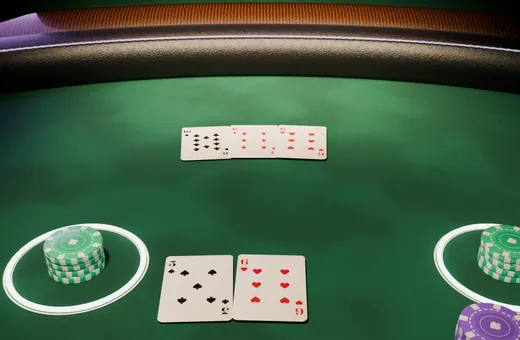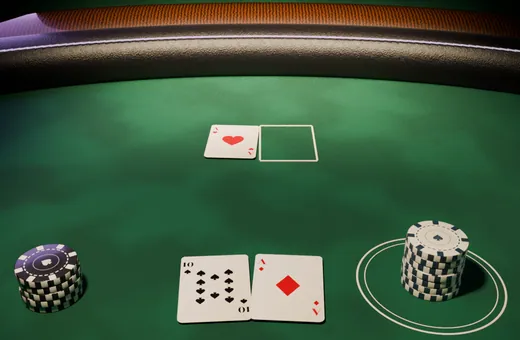
Dealer stands on soft 17
- Cards A, 6. soft 17, dealer stands
Dealer finishes 17
A soft 17 is a hand that totals 17 with an ace counted as 11, such as ace and six. Some tables make the dealer stand on it and others make the dealer take another card, and that one choice is among the rules that change the house edge. Standing on all 17s is often written S17, and hitting soft 17 is written H17. With six decks, doubling after a split and a natural paying 3 to 2, the dealer hitting soft 17 gives 0.62%, and the dealer standing gives 0.41%. That is 0.21 points in the player's favour, from a rule that is printed on the felt in a few words.
A hand is soft when it holds an ace that can count as 11 without the total passing 21. Ace and six is soft 17: it is 17 now, and it would be 7 if the ace counted as 1. Ace, two and four is also soft 17, and so are ace, ace and five, and ace, three and three. A hand of ten and seven is hard 17, because it has no ace to count as 11.
The dealer has no choices in blackjack. The dealer draws a card on any total up to 16, stands on any hard 17 or more, and stands on soft 18 and more. The only total where tables disagree is soft 17. Under S17 the dealer stands on it, like any other 17. Under H17 the dealer treats it as a hand still worth improving and draws one more card.
The reason the rule exists is that a soft 17 is a special case: the dealer cannot bust on the next card. Any card leaves the hand at 12 or better, so the first draw cannot bust the dealer and gives a chance to move up. It can also drop the hand below 17, for example ace and six drawing a five makes hard 12, and the dealer then keeps drawing and may bust later. Whether the table lets the dealer take that draw is a choice about the price of the game.
Demo
The extra card cannot hurt: a ten turns soft 17 into hard 17, the same total.
Dealer finishes 17
Dealer finishes 17
A small card lifts the hand from 17 to a strong soft 20.
Dealer finishes 17
Dealer finishes 20
The hit lands on hard 16, so the dealer must draw again.
Dealer finishes 17
Dealer finishes 21
The hit lands on hard 15, and the next card is a ten.
Dealer finishes 17
Dealer finishes Bust
Soft 17 made with three cards is still soft 17.
Dealer finishes 17
Dealer finishes Bust
Two aces and a five make soft 17 as well: one ace counts 11, the other 1.
Dealer finishes 17
Dealer finishes 21
Hard 17 is not soft: both rules stand, so the dealer draws nothing.
Dealer finishes 17
Dealer finishes 17
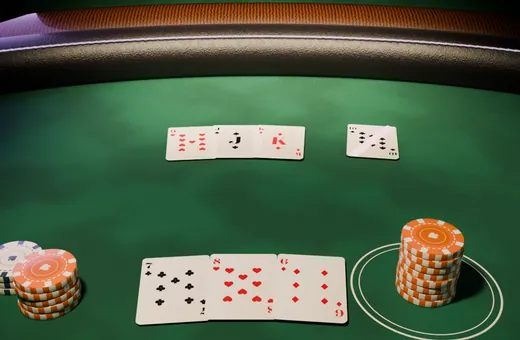
The cards are fixed for each example, so this shows what the rule does to one hand. It does not say how often each case comes up. For that, see the house edge figures on this page.
Take a dealer holding ace and six. Every card the dealer might draw does one of three things, and the arithmetic does not depend on the table.
| Card drawn | Dealer hand afterwards | What follows |
|---|---|---|
| Ace | Soft 18 | Dealer stands |
| Two | Soft 19 | Dealer stands |
| Three | Soft 20 | Dealer stands |
| Four | Soft 21 | Dealer stands |
| Five | Hard 12 | Dealer draws again |
| Six | Hard 13 | Dealer draws again |
| Seven | Hard 14 | Dealer draws again |
| Eight | Hard 15 | Dealer draws again |
| Nine | Hard 16 | Dealer draws again |
| Ten, jack, queen or king | Hard 17 | Dealer stands |
An ace, two, three or four lifts the dealer to 18 through 21, hands that beat a player standing on 17. A ten-value card returns the dealer to exactly the same total, hard 17. A five through a nine sends the dealer back to a stiff hand that must draw again and can bust. So the extra draw has three outcomes: it improves the hand, it leaves the total at 17, or it risks a bust. The improvements are the reason the rule favours the house, and the busts are the reason the effect is not larger.
The demo above plays this out with fixed cards, so you can see one case at a time. It shows what the rule does to a single hand and says nothing about how often each case comes up. For frequencies, use the house edge figures below.
The comparison table used across this site is six decks, double after split allowed, a natural paying 3 to 2 and no surrender. Changing only the soft 17 rule moves it as follows.
| Rule set | House edge |
|---|---|
| Comparison rules, dealer hits soft 17 | 0.62% |
| Same rules, dealer stands on soft 17 | 0.41% |
| Change from standing | 0.21 points less |
The figure is the average result of one round in units of the starting bet, with correct play and no card counting. It does not depend on how strong you are as a player. It is a property of the table. Standing on soft 17 is worth 0.21 points, close to what moving from six decks to two saves, 0.23. Late surrender, by comparison, is worth 0.09, and allowing resplit aces 0.07.
Because both rules are documented for the same games, the effect can be read straight from the games. Every pair below has the same rules except for the soft 17 line.
| Game | Dealer stands | Dealer hits |
|---|---|---|
| Atlantic City rules | 0.36% (Atlantic City blackjack, dealer stands on soft 17. House edge per starting bet: the average loss per round as a share of the bet placed before the cards are dealt, doubles and splits included in the result. Rules: 8 decks, dealer stands on soft 17, dealer checks for blackjack with a hole card, blackjack pays 3:2, double on any first two cards, double after split, split up to 4 hands, aces are not resplit, one card to each split ace, late surrender. The player follows the printed strategy chart for these rules from a full shoe, and never takes insurance or even money.) | 0.56% (Atlantic City blackjack, dealer hits soft 17. House edge per starting bet: the average loss per round as a share of the bet placed before the cards are dealt, doubles and splits included in the result. Rules: 8 decks, dealer hits soft 17, dealer checks for blackjack with a hole card, blackjack pays 3:2, double on any first two cards, double after split, split up to 4 hands, aces are not resplit, one card to each split ace, late surrender. The player follows the printed strategy chart for these rules from a full shoe, and never takes insurance or even money.) |
| Spanish 21 | 0.41% (Spanish 21, dealer stands on soft 17. House edge per starting bet: the average loss per round as a share of the bet placed before the cards are dealt, doubles and splits included in the result. Rules: 6 decks of 48 cards (the ten-spot cards removed), dealer stands on soft 17, dealer checks for blackjack with a hole card, blackjack pays 3:2, double on any number of cards, double after split, split up to 4 hands, aces may be resplit, split aces may be hit, late surrender, a doubled bet may be rescued, a player 21 beats a dealer 21, bonus payouts: 5-card 21 pays 3:2, 6-card 21 pays 2:1, 7-or-more-card 21 pays 3:1, 6-7-8 mixed pays 3:2, 6-7-8 suited pays 2:1, 6-7-8 in spades pays 3:1, 7-7-7 mixed pays 3:2, 7-7-7 suited pays 2:1, 7-7-7 in spades pays 3:1, bonuses are not paid on split hands. The player follows the printed strategy chart for these rules from a full shoe, and never takes insurance or even money.) | 0.81% (Spanish 21, dealer hits soft 17. House edge per starting bet: the average loss per round as a share of the bet placed before the cards are dealt, doubles and splits included in the result. Rules: 6 decks of 48 cards (the ten-spot cards removed), dealer hits soft 17, dealer checks for blackjack with a hole card, blackjack pays 3:2, double on any number of cards, double after split, split up to 4 hands, aces may be resplit, split aces may be hit, late surrender, a doubled bet may be rescued, a player 21 beats a dealer 21, bonus payouts: 5-card 21 pays 3:2, 6-card 21 pays 2:1, 7-or-more-card 21 pays 3:1, 6-7-8 mixed pays 3:2, 6-7-8 suited pays 2:1, 6-7-8 in spades pays 3:1, 7-7-7 mixed pays 3:2, 7-7-7 suited pays 2:1, 7-7-7 in spades pays 3:1, bonuses are not paid on split hands. The player follows the printed strategy chart for these rules from a full shoe, and never takes insurance or even money.) |
| Free Bet Blackjack | 0.71% (Free Bet Blackjack, dealer stands on soft 17. House edge per starting bet: the average loss per round as a share of the bet placed before the cards are dealt, doubles and splits included in the result. Rules: 6 decks, dealer stands on soft 17, dealer checks for blackjack with a hole card, blackjack pays 3:2, double on any first two cards, double after split, split up to 4 hands, aces may be resplit, one card to each split ace, no surrender, a dealer 22 pushes every hand still in play, free doubles on hard 9, 10 and 11 (first two cards), free splits on every pair except tens. The player follows the printed strategy chart for these rules from a full shoe, and never takes insurance or even money. Free doubles and free splits are paid by the house, so they add to the result but not to the chips the player wagers.) | 1.02% (Free Bet Blackjack, dealer hits soft 17. House edge per starting bet: the average loss per round as a share of the bet placed before the cards are dealt, doubles and splits included in the result. Rules: 6 decks, dealer hits soft 17, dealer checks for blackjack with a hole card, blackjack pays 3:2, double on any first two cards, double after split, split up to 4 hands, aces may be resplit, one card to each split ace, no surrender, a dealer 22 pushes every hand still in play, free doubles on hard 9, 10 and 11 (first two cards), free splits on every pair except tens. The player follows the printed strategy chart for these rules from a full shoe, and never takes insurance or even money. Free doubles and free splits are paid by the house, so they add to the result but not to the chips the player wagers.) |
The size of the difference is not the same in every game. Spanish 21, with tens removed from the decks, has the largest gap of the three. Rule effects are not additive, so read the table for the game you play rather than carrying one number across.
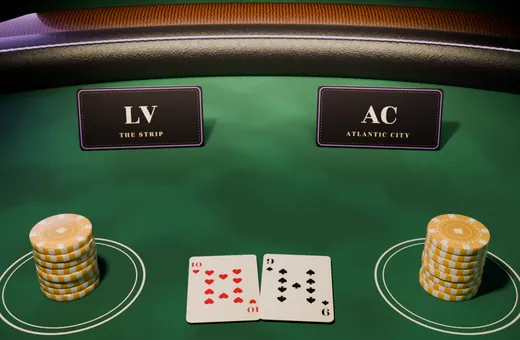
Each column of the rule matrix shows one setting per game, taken from the rule set in the regulator documents. In those sets the dealer stands on soft 17 in Atlantic City blackjack, European Blackjack and Spanish 21. The dealer hits soft 17 in the comparison rules, Double Deck, Blackjack Switch, Double Exposure, Free Bet Blackjack, Single Deck 6:5 and Pontoon.
Those are the reference settings, not a promise about every table. The regulator documents leave the rule to the casino in several places. New Jersey lets each casino choose it, and the Las Vegas Strip documents do not state it at all. Spanish 21 is documented with both rules, which is why its page gives both figures. When you look at the rules for a real table, believe the felt.
Compare whole rule sets, not one line. Several of the hit-soft-17 games in the list also have other rules that cost the player, such as a short payout or a limit on doubling, and the house edge calculator adds them together for you.
The rule also moves a few close decisions. In the strategy data behind this site, a hard 11 against a dealer ace and a soft 18 against a dealer 2 are doubles at the six-deck table where the dealer hits soft 17, and they are not doubles at the tables where the dealer stands. The list of changed decisions is short, and playing the chart for the wrong rule costs little in one round, but it adds up over many.
The larger lesson is that the correct play is a property of the whole rule set. A chart printed for S17 is wrong in a few cells at an H17 table, and a chart printed for a single deck is wrong in others. The coach at each game's play table uses the rule set of that game.
Most felts print it in a line near the dealer's cards. The usual wordings are "Dealer must draw to 16 and stand on all 17s", which is S17, and "Dealer must draw to 16 and hit soft 17", which is H17. Online, the rules or help screen of the game states it in the same terms.
If the felt is silent, ask. The rule is not a secret and it changes the price of every hand you play. Because it is a small rule with a large effect, it is a good first question when two tables look identical.
This page describes rules and their cost for information. Use the play tables with play money to see the rule in action, and play within limits you can afford.
Questions
A soft 17 is a hand that totals 17 with an ace counted as 11, such as ace and six, or ace, two and four. It is called soft because drawing another card cannot bust it. A hand of ten and seven is a hard 17, with no ace counted as 11.
It depends on the table. Some tables make the dealer stand on all 17s, which is S17, and others make the dealer hit soft 17, which is H17. The rule is normally printed on the felt, and it changes the house edge by 0.21 points in the comparison game.
S17 is better for the player. With six decks, double after split and a 3 to 2 natural, the house edge is 0.41% when the dealer stands on soft 17 and 0.62% when the dealer hits it. The dealer's extra draw gives the house another chance to improve a 17.
Because it raises the house edge. The rule gives the dealer an extra draw on a hand that cannot bust on that card. The draw does not help on every hand, since it can leave a hard total under 17 that then busts, but on average the dealer comes out ahead. Casinos that want a higher edge without changing the payout often choose H17.
In the comparison game it raises the house edge by 0.21 points, from 0.41% to 0.62%. In Spanish 21 the gap is larger, from 0.41% (Spanish 21, dealer stands on soft 17. House edge per starting bet: the average loss per round as a share of the bet placed before the cards are dealt, doubles and splits included in the result. Rules: 6 decks of 48 cards (the ten-spot cards removed), dealer stands on soft 17, dealer checks for blackjack with a hole card, blackjack pays 3:2, double on any number of cards, double after split, split up to 4 hands, aces may be resplit, split aces may be hit, late surrender, a doubled bet may be rescued, a player 21 beats a dealer 21, bonus payouts: 5-card 21 pays 3:2, 6-card 21 pays 2:1, 7-or-more-card 21 pays 3:1, 6-7-8 mixed pays 3:2, 6-7-8 suited pays 2:1, 6-7-8 in spades pays 3:1, 7-7-7 mixed pays 3:2, 7-7-7 suited pays 2:1, 7-7-7 in spades pays 3:1, bonuses are not paid on split hands. The player follows the printed strategy chart for these rules from a full shoe, and never takes insurance or even money.) to 0.81% (Spanish 21, dealer hits soft 17. House edge per starting bet: the average loss per round as a share of the bet placed before the cards are dealt, doubles and splits included in the result. Rules: 6 decks of 48 cards (the ten-spot cards removed), dealer hits soft 17, dealer checks for blackjack with a hole card, blackjack pays 3:2, double on any number of cards, double after split, split up to 4 hands, aces may be resplit, split aces may be hit, late surrender, a doubled bet may be rescued, a player 21 beats a dealer 21, bonus payouts: 5-card 21 pays 3:2, 6-card 21 pays 2:1, 7-or-more-card 21 pays 3:1, 6-7-8 mixed pays 3:2, 6-7-8 suited pays 2:1, 6-7-8 in spades pays 3:1, 7-7-7 mixed pays 3:2, 7-7-7 suited pays 2:1, 7-7-7 in spades pays 3:1, bonuses are not paid on split hands. The player follows the printed strategy chart for these rules from a full shoe, and never takes insurance or even money.). The size varies by game, so read the figure for the game you are playing.
No. In the standard rules the dealer draws on 16 or less, stands on hard 17 or more, and stands on every soft total from 18 up. Soft 17 is the only total where tables differ. A few unusual games hit soft 18, but they are not in the games covered here.
Yes. Any dealer hand that totals 17 with an ace counted as 11 is a soft 17, whether it has two cards or four. Ace, two and four is soft 17, and so is ace, ace and five. The demo above includes both cases.
No. In the reference rule sets, the dealer stands in Atlantic City blackjack, European Blackjack and Spanish 21, and hits in Double Deck, Blackjack Switch, Double Exposure, Free Bet Blackjack, Single Deck 6:5 and Pontoon. Real tables vary, so check the felt.
Slightly. A few borderline decisions, such as doubling and surrendering some stiff hands, move with the rule. The correct chart belongs to the whole rule set, so use the chart for the soft 17 rule, deck count and other rules of your own table.
Yes. The demo on this page deals fixed cards under both rules side by side, and the play tables on the game pages use each game's own rule with play money. Nothing here involves real money, and play within limits you can afford.
Keep reading
Sources