Blackjack 6 to 5 vs 3 to 2: What the Short Payout Costs You
A natural blackjack pays 3 to 2 at a full-pay table and 6 to 5 at a short-pay table. On a bet of 10 that is 15 against 12, and the missing 3 is small enough to miss when you sit down. It is not small over a session. Under the comparison rules used on this site, six decks with the dealer hitting soft 17, the house edge is 0.62% at 3 to 2 and 1.98% at 6 to 5, a rise of 1.36 percentage points from that one rule. A payout of 1 to 1 takes it to 2.88%. This page shows what the rule is, where it comes from, how often it bites and what it costs you, with a calculator for your own bet size and number of hands.
What 3 to 2, 6 to 5 and 1 to 1 Mean at the Table
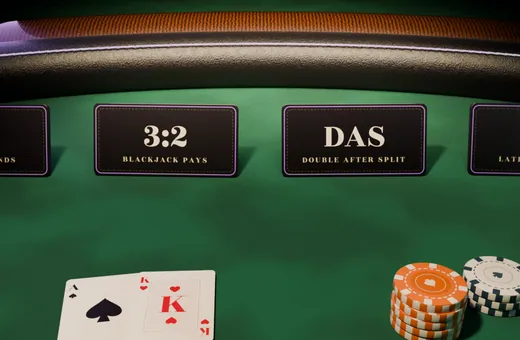
A blackjack payout is a ratio between what you win and what you bet. Three to two means you win three units for every two you stake, which is 1.5 times the bet. Six to five means six units for every five staked, which is 1.2 times the bet. One to one, also called even money, pays back the bet you put in and nothing more.
Only a natural is affected. A natural is an ace with a ten-value card as your first two cards. Every other winning hand, including a three-card 21, pays 1 to 1 at all three kinds of table. That is why the rule looks harmless: it changes what one kind of hand is worth, and that hand is not the most common thing you hold.
Worked out on three bet sizes, the payouts are:
| Your bet | Natural at 3 to 2 | Natural at 6 to 5 | Natural at 1 to 1 |
|---|---|---|---|
| 10 | 15 | 12 | 10 |
| 25 | 37.50 | 30 | 25 |
| 100 | 150 | 120 | 100 |
The gap is a fixed share of the bet: 0.3 of the bet against 3 to 2, and 0.5 of the bet at even money. A bet of 100 loses 30 on every natural at a 6 to 5 table, and the loss grows in step with the stake.
There is a practical side effect too. A 6 to 5 payout does not divide neatly into small chips. The New Jersey rules require every wager at a 6 to 5 table to be a multiple of five dollars, so the payout comes out in whole chips. If you like to bet in small odd amounts, the rule can also change how you bet.
How Often You Are Dealt the Hand That Pays Less
The cost of the rule is the price of each natural multiplied by how many naturals you get. The second number is fixed by the cards. At six decks the chance that your first two cards are an ace and a ten-value card is 4.75% (Chance that the first two cards dealt to a player are an ace and a ten-valued card. Rules: 6 decks. Worked out exactly from a full shoe.), or 1 in 21.1 (The chance of a natural as one hand in so many. Rules: 6 decks. Worked out exactly from a full shoe.). At a single deck it is 4.83% (Chance that the first two cards dealt to a player are an ace and a ten-valued card. Rules: a single deck. Worked out exactly from a full shoe.), which is 1 in 20.7 (The chance of a natural as one hand in so many. Rules: a single deck. Worked out exactly from a full shoe.). The chance does not change with the payout, so a short-pay table takes the same fraction of hands and pays less on each.
This is also why the rule feels different in a short session and a long one. In a short session you might see no natural at all, or several close together. The average cost is small in any one hour and large in a season. A shortfall of 0.3 of your bet on each natural only becomes visible when you count naturals over many hands, so a player who never tracks the total sees mainly the ordinary wins and losses.
It also explains why the rule cannot be dodged by strategy. There is no play that helps you against a short natural payout, because the natural is dealt, not played. What you control is the choice of table, and everything else on this page is about making that choice with the numbers in front of you.
What the Short Payout Costs in House Edge
The house edge measures the average loss as a share of the starting bet, with correct play. All figures below use the rule grid behind this site: six decks, dealer hits soft 17, double after split allowed, and the same strategy at every table. Only the blackjack payout changes.
- Blackjack pays 3 to 2: 0.62%.
- Blackjack pays 6 to 5: 1.98%, which is 1.36 percentage points higher.
- Blackjack pays 1 to 1: 2.88%, which is 2.27 percentage points higher.
Seen as a multiple, the change is large. The house edge at 6 to 5 is several times the edge at 3 to 2, from that one rule alone. That is a bigger jump than most of the rule changes listed on the house edge page, where deck count, doubling limits and splitting rules each move the figure by a fraction of a point.
The calculator below turns the percentage points into an amount. It multiplies your bet by the number of hands and by the added edge, and it labels the answer an average. Real results scatter widely around an average: any single session can finish ahead at a 6 to 5 table, and many do. The average is what the rule takes from the whole crowd over time.
Calculator
What the Short Payout Costs You: Bet Size and Hands
Average extra cost
0
Set a bet and a number of hands.
- Naturals expected
- 0
- Short by, per natural
- 0
- Per 100 hands
- 0
| Blackjack pays | House edge | Added to 3 to 2 |
|---|---|---|
| 3 to 2 | 0.62% | none |
| 6 to 5 | 1.98% | 1.36 points |
| 1 to 1 | 2.88% | 2.27 points |
An average over many hands, not a forecast: a short session can finish well above or below it. Rates are per starting bet with correct play, from the rule grid. The naturals line uses the chance of an ace and a ten-value card in the first two cards, 4.75% at six decks.
Single Deck at 6 to 5: When a Good-Looking Table Is Not
Deck count is the other big lever on the house edge, and a single deck lowers it sharply. The grid puts a single deck, with the comparison rules otherwise unchanged and a natural at 3 to 2, at 0.05%, against 0.62% for six decks.
A 6 to 5 payout takes back what the deck count gave. The grid figure for a single deck with a natural at 6 to 5 is 1.44%, and the single deck page on this site puts the same game at 1.44% (Single deck blackjack paying 6 to 5. House edge per starting bet: the average loss per round as a share of the bet placed before the cards are dealt, doubles and splits included in the result. Rules: 1 deck, dealer hits soft 17, dealer checks for blackjack with a hole card, blackjack pays 6:5, double on any first two cards, double after split, split up to 4 hands, aces are not resplit, one card to each split ace, no surrender. The player follows the printed strategy chart for these rules from a full shoe, and never takes insurance or even money.). That is more than twice the 0.62% of the six-deck table with full pay, so the small deck no longer works in the player's favour. See single deck blackjack for the rules and the strategy differences.
The lesson is to read the payout before the deck count. A sign that says single deck is not a reason to sit down, and a sign that says 6 to 5 is a reason to check everything else against the full-pay alternative.
What Else Changes at a 6 to 5 Table
Regulators treat 6 to 5 as its own variation, and several other rules move with it. The New Jersey rules do not allow surrender on a table that offers the 6 to 5 variation, and they let the casino prohibit doubling down after splitting pairs at such a table. They also fix the dealer's draw: at a 6 to 5 table the dealer keeps drawing until a hard 17 or any total of 18 to 21, which means the dealer hits soft 17. The Massachusetts rules add that the even-money option for a player blackjack against a dealer ace is void when the casino chooses to pay 6 to 5.
Each of those choices costs the player something further. The grid has a row for a six-deck table where the payout is 6 to 5, doubling is allowed on hard 10 and 11 only, doubling after split is off and splits are limited to two hands. It comes to 2.34%, against 1.98% for a table with 6 to 5 alone. A table that shortens the payout is often the same table that tightens the other rules, so the true cost can be larger than the payout figure alone.
The regulator text permits 6 to 5 as one of a set of payout options and sets notice requirements for offering it. The table felt and signage are the record of which one applies. If the felt is not clear, ask before you play.
How to Read the Payout Before You Sit Down
Look for the printed line under the layout. Full pay reads BLACKJACK PAYS 3 TO 2. A short table reads BLACKJACK PAYS 6 TO 5. Some tables print it as 1 to 1 or even money on the natural. Check the felt at each table rather than assuming from the casino: a room can run both kinds at once, often at different minimum bets.
Then compare like with like. A 3 to 2 table with a higher minimum bet can cost you less per hour than a 6 to 5 table with a lower minimum, once you multiply by how much you actually stake. The calculator above lets you enter both. If you will play 500 hands at 25, run the numbers before choosing the cheaper table.
Regulator texts also list optional bonus payouts that a casino may add, such as a single ace and face card combination designated by the casino paying 2 to 1. Those are separate from the table payout, and the felt says which of them applies.
Questions
Frequently asked questions
Does 6 to 5 change how I should play my hand?
Little. A natural is dealt, not played, so the payout gives you no decision to make. What can change a few plays is the rest of the table, such as a dealer who hits soft 17. The single deck page covers the adjustments for the short-pay single-deck game.
Is 6 to 5 legal?
Yes, where the regulator allows it. New Jersey and Massachusetts both list 6 to 5 as an accepted payout for a blackjack, next to 3 to 2, and set notice rules for offering it. It is a permitted variation, so the question is one of price, not legality.
How much more does 6 to 5 cost than 3 to 2?
Under the comparison rules on this site it adds 1.36 percentage points, taking the house edge from 0.62% to 1.98%. Use the calculator on this page to turn that into an amount for your own bet size and hands. It is an average, and single sessions vary.
Is even money on a blackjack the same as 1 to 1?
Not exactly. A table that pays every natural at 1 to 1 has a house edge of 2.88%. Even money as an offer is a separate choice made when the dealer shows an ace, and it settles only that one hand at 1 to 1. The rules pages on insurance cover it.
Does a single-deck table at 6 to 5 beat a six-deck table at 3 to 2?
Under the rules in the grid, no. The single-deck 6 to 5 figure is 1.44%, while a six-deck table at 3 to 2 sits at 0.62%. The deck count helps you, but the short payout takes back more than it gave.
Why do casinos offer 6 to 5 at all?
The regulator documents give no reason. They list 6 to 5 as one permitted payout option, and the measured effect is a higher house edge. The player's protection is to know which payout applies before placing a bet, because the felt is the only place it is printed.
What do I do if I cannot find a 3 to 2 table?
Compare the total cost. Multiply your bet by the hands you expect to play, add the extra edge for 6 to 5, and set that against the price of not playing. Nothing on this site tells you to play or not. It shows the number, and the choice is yours.
How often do I get a natural?
At six decks, 4.75% (Chance that the first two cards dealt to a player are an ace and a ten-valued card. Rules: 6 decks. Worked out exactly from a full shoe.) of hands start with an ace and a ten-value card, which is 1 in 21.1 (The chance of a natural as one hand in so many. Rules: 6 decks. Worked out exactly from a full shoe.). A single deck gives 4.83% (Chance that the first two cards dealt to a player are an ace and a ten-valued card. Rules: a single deck. Worked out exactly from a full shoe.), or 1 in 20.7 (The chance of a natural as one hand in so many. Rules: a single deck. Worked out exactly from a full shoe.). The cards fix that chance, so a short-pay table takes the same share of hands as a full-pay table and simply pays less on each one.
Does the payout rule apply to other games on this site?
It applies to any blackjack-style game where a natural is paid at a stated ratio. Regulator texts for Blackjack Switch pay a natural at 1 to 1, while Spanish 21 pays it at 3 to 2 and adds bonus hands.
Sources
Rule documents behind this page
- New Jersey Division of Gaming EnforcementN.J.A.C. 13:69F Chapter 69F, Subchapter 2 - Blackjack rules of the gameRead
- Massachusetts Gaming CommissionBlackjack Rules (10/08/2020)Read
- Washington State Gambling CommissionBlackjack Switch rules of play (last revised 8-2-2010; PDF also carries the 2023 approval letter)Read
- Washington State Gambling CommissionBlackjack Game Rules (revised April 2018) - base rules referenced by every WSGC variantRead