Match the Dealer Blackjack Side Bet: How It Pays and the Odds
Match the Dealer is a blackjack side bet on one comparison: each of your first two cards against the dealer's upcard. A card of the same rank is a match, the same rank and suit is a suited match, and the pay table sets what each combination returns. This page gives the two pay tables that regulator documents print in full and that can be counted exactly, a house edge of 4.06% (House edge, Match the Dealer, pay table 22 / 15 / 11 / 8 / 4, 6 decks. Exact count over a fresh, randomly shuffled shoe.) on the six-deck table and 3.67% (House edge, Match the Dealer, pay table 28 / 17 / 14 / 6 / 3, 8 decks. Exact count over a fresh, randomly shuffled shoe.) on the eight-deck table, and the chance of every outcome. It also lists the tables that are documented but carry no figure, and it says why.
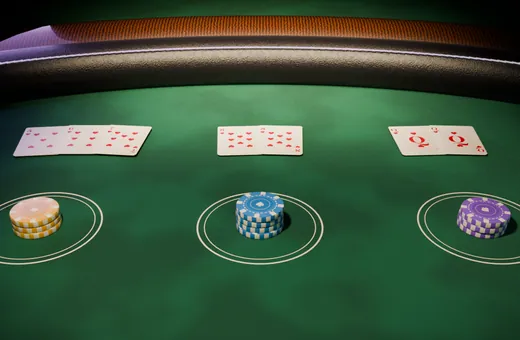
How the Match the Dealer Side Bet Works
The bet is placed before the cards are dealt, in its own betting spot next to the main wager. It has nothing to do with whether your hand beats the dealer. Once your two cards and the dealer's first card are face up, the bet is settled right away. New Jersey requires losing bets to be collected and winning bets paid immediately after the second card is dealt to each player, before any further card is dealt to anyone. By the time you decide to hit, stand, double or split, Match the Dealer is already paid or lost.
Only three cards matter: your first two cards and the dealer's upcard. The dealer's hole card is not part of the bet, so nothing the dealer draws later, and nothing you draw, can change it. The result is one of six: no match, or one of five winning combinations. Most rounds are the first. With the six-deck pay table the bet pays in only 14.27% (Chance of a win, Match the Dealer, pay table 22 / 15 / 11 / 8 / 4, 6 decks. Exact count over a fresh, randomly shuffled shoe.) of rounds, so about 85.73% of rounds lose the stake.
A short example makes the structure clear. The dealer shows the seven of hearts. You are dealt the seven of clubs and the queen of spades. One of your cards matches the upcard in rank and neither is a suited match, so the round lands in the one-rank-match line of the pay table. Had the first card been the seven of hearts itself, that card would be a suited match, which only a shoe with more than one deck can produce.
What Counts as a Match
A match is the same rank, and only the same rank. A seven matches a seven. A queen matches a queen. A ten, a jack, a queen and a king all count as ten in the main game, but for this bet each of them matches only its own rank: a king against a queen upcard is not a match. Aces match aces.
A suited match is the same rank in the same suit as the upcard. It needs a second copy of one exact card, which is why a single deck cannot produce it and why it becomes more likely as decks are added to the shoe. A suited match is always also a rank match, so the pay table lists it as its own combination and pays it more.
Because the bet compares two player cards with one dealer card, the five winning combinations are these:
- One rank match, the other card not matching.
- One suited match, the other card not matching.
- Two rank matches, neither suited.
- One suited match and one rank match.
- Two suited matches.
Two suited matches need both of your cards to be the exact upcard, so they are the rarest combination. New Jersey's rule words it the same way: the bet wins if either of the first two cards matches the dealer's first card, and a jack, queen or king matches only a card of identical description.
Match the Dealer Pay Tables
Two pay tables are printed in full and can be counted exactly. New Jersey and Pennsylvania both print one for six decks and one for eight decks, and they pay per matching card. On the six-deck table a rank match pays 4 to 1 and a suited match 11 to 1; if both cards match, each is paid on its own, so the two-card lines are sums of the single-card pays. The eight-deck table pays 3 to 1 and 14 to 1 per card in the same way. The New Jersey text sets these as the least a casino may pay, so the table posted at the table governs; the numbers below are the printed ones.
| Combination | Six decks pays | Chance | Eight decks pays | Chance |
|---|---|---|---|---|
| One rank match | 4 to 1 | 10.75% | 3 to 1 | 10.73% |
| Two rank matches | 8 to 1 | 0.32% | 6 to 1 | 0.32% |
| One suited match | 11 to 1 | 2.99% | 14 to 1 | 3.13% |
| Suited match and rank match | 15 to 1 | 0.19% | 17 to 1 | 0.20% |
| Two suited matches | 22 to 1 | 0.021% | 28 to 1 | 0.024% |
Read the chance columns before the pay columns. A pay of 28 to 1 sounds large, and it is paid on a hand that comes about 1 in 4,091. The pays are set against those odds, and the house edge is what remains of the difference.
The explorer below opens each table, shows every outcome with its pay, odds and chance, and states what the count assumes.
Explorer
Match the Dealer: Pay Tables, Odds and House Edge
Each of your first two cards is compared with the dealer upcard. A card of the same rank is a match, and the same rank and suit is a suited match. Tens, jacks, queens and kings match only their own rank. The pay table gives the total paid for each combination of matches.
- Played on
- Blackjack, and Spanish 21 on 48-card decks
- Cards that count
- Your first two cards and the dealer upcard
- Settled
- Right after the deal, before anyone acts
- House edge over every pay table
- 3.67% to 4.06%
Scale from zero to 30 percent. The green tick is the main game at 0.62%, six decks, dealer hits soft 17.
Documented, with no figure
- Massachusetts 6-deck (alternate)No figureThe table is printed as an image in the rules; its rows have not yet been read back against the document.
- Massachusetts 8-deck (alternate)No figureThe table is printed as an image in the rules; its rows have not yet been read back against the document.
- Massachusetts 5-deckNo figureThe table is printed as an image in the rules; its rows have not yet been read back against the document.
- Massachusetts 4-deckNo figureThe table is printed as an image in the rules; its rows have not yet been read back against the document.
- Massachusetts 3-deckNo figureThe table is printed as an image in the rules; its rows have not yet been read back against the document.
- Massachusetts 3-deck (alternate)No figureThe table is printed as an image in the rules; its rows have not yet been read back against the document.
- Massachusetts 2-deckNo figureThe table is printed as an image in the rules; its rows have not yet been read back against the document.
- Massachusetts 2-deck (alternate 1)No figureThe table is printed as an image in the rules; its rows have not yet been read back against the document.
- Massachusetts 2-deck (alternate 2)No figureThe table is printed as an image in the rules; its rows have not yet been read back against the document.
- Washington SP21 approval, pay table 1 (Spanish 21)No figureThe table is in a regulator approval for Spanish 21 on 48-card decks; its figure is not released yet.
- Washington SP21 approval, pay table 2 (Spanish 21)No figureThe table is in a regulator approval for Spanish 21 on 48-card decks; its figure is not released yet.
- Washington SP21 approval, pay table 3 (Spanish 21)No figureThe table is in a regulator approval for Spanish 21 on 48-card decks; its figure is not released yet.
Bar length in the outcome table is on a log scale, from 1 in a million to certain, so rare awards stay visible. Bars in the deck count chart start at zero.
Match the Dealer House Edge
The house edge is the average loss as a share of the side bet. It is 4.06% (House edge, Match the Dealer, pay table 22 / 15 / 11 / 8 / 4, 6 decks. Exact count over a fresh, randomly shuffled shoe.) on the six-deck table and 3.67% (House edge, Match the Dealer, pay table 28 / 17 / 14 / 6 / 3, 8 decks. Exact count over a fresh, randomly shuffled shoe.) on the eight-deck table. The main game, with correct play under the comparison rules used on this site, costs 0.62% (Comparison rules: 6 decks, dealer hits soft 17, double after split, blackjack pays 3:2. House edge per starting bet: the average loss per round as a share of the bet placed before the cards are dealt, doubles and splits included in the result. Rules: 6 decks, dealer hits soft 17, dealer checks for blackjack with a hole card, blackjack pays 3:2, double on any first two cards, double after split, split up to 4 hands, aces are not resplit, one card to each split ace, no surrender. The player follows the printed strategy chart for these rules from a full shoe, and never takes insurance or even money.), so even the cheaper Match the Dealer table costs several times as much per unit staked.
The two edges differ, and it would be a mistake to read the difference as the effect of two extra decks. The pay tables are different too. The eight-deck table pays a higher top prize and lower pays on the common combinations, and the edge you see is the net of those choices as well as of the shoe. What the data does support is narrower and still useful: on a fresh shoe, the six-deck table with its printed pays costs more than the eight-deck table with its printed pays. A player who reads the pay table on the felt and finds neither of these two has met a table that is not covered here.
The chance of any win is close on both tables, 14.27% (Chance of a win, Match the Dealer, pay table 22 / 15 / 11 / 8 / 4, 6 decks. Exact count over a fresh, randomly shuffled shoe.) and 14.40% (Chance of a win, Match the Dealer, pay table 28 / 17 / 14 / 6 / 3, 8 decks. Exact count over a fresh, randomly shuffled shoe.). The single rank match carries most of it, 10.75% at six decks. That is why the pay on a single rank match moves the edge more than any of the top prizes: it is the outcome that happens often enough for a change in its pay to matter.
Deck Count and Match the Dealer
Every figure on this page is an exact count of every combination of cards from a fresh, randomly shuffled shoe. Deck count changes the counts in a predictable way. With one deck, after the dealer shows a seven there are three sevens left, and none of them is the same suit as the upcard, so a suited match cannot occur. With two decks there is one exact copy of the upcard left in the shoe, and a suited match is possible but two suited matches are not. Each added deck adds another exact copy of every card, so suited matches grow more likely while the plain rank matches change little.
You can see the direction in the two tables. A single suited match is 2.99% of rounds at six decks and 3.13% at eight. A single rank match moves the other way, from 10.75% to 10.73%. The printed tables follow the same direction: the eight-deck table pays more than the six-deck table on every suited combination and less on the rank-only ones.
Cards played earlier in the same shoe are not removed from any figure here. A count that followed the cards already dealt would give a different number for every round, and nothing on this page is such a count.
Does Match the Dealer Change How You Play the Hand?
No. The bet is settled on cards that your decisions cannot reach. It is decided at the deal, before you act, so hitting, standing, doubling and splitting cannot alter it. The main hand follows the strategy that fits the rules of the game, whatever you staked on the side.
There is one subtle link worth naming. Your two cards and the upcard leave the shoe, so they change what the dealer and the other players receive. That is true of every card in blackjack and it is already part of the main game. It does not turn a side bet into part of your strategy.
Other Match the Dealer Tables and Why They Show No Figure
Regulator documents print more Match the Dealer tables than the two above. Massachusetts prints tables for two, three, four and five decks and alternates for several deck counts. They are printed as images in the rules, and the rows have not been read back against the document, so they carry no figure here. Washington State also approves Match the Dealer tables for Spanish 21, which is played with 48-card decks that have no tens. Those are counted on a different shoe and are not released.
A missing figure means only that: there is no figure. It does not mean the bet at those tables costs nothing or costs the same as another table. The explorer lists each of them by name under the label No figure.
Questions
Frequently asked questions
What is the Match the Dealer side bet?
It is an optional wager placed before the deal that pays when one or both of your first two cards match the dealer's upcard in rank. A match in rank and suit pays more. It is settled at once, on those three cards, and does not depend on who wins the main hand.
How does Match the Dealer pay?
It pays by combination, and the pay table posted at the table governs. On the six-deck table one rank match pays 4 to 1, one suited match 11 to 1 and two suited matches 22 to 1. Each matching card is paid on its own, and some regulator texts state the pays as minimums.
What is the house edge of Match the Dealer?
On the six-deck table, whose top pay is 22 to 1, it is 4.06% (House edge, Match the Dealer, pay table 22 / 15 / 11 / 8 / 4, 6 decks. Exact count over a fresh, randomly shuffled shoe.). On the eight-deck table it is 3.67% (House edge, Match the Dealer, pay table 28 / 17 / 14 / 6 / 3, 8 decks. Exact count over a fresh, randomly shuffled shoe.). Both are edges on the side bet itself, measured against the stake on the side bet, and both are far above the main game, which sits at 0.62% (Comparison rules: 6 decks, dealer hits soft 17, double after split, blackjack pays 3:2. House edge per starting bet: the average loss per round as a share of the bet placed before the cards are dealt, doubles and splits included in the result. Rules: 6 decks, dealer hits soft 17, dealer checks for blackjack with a hole card, blackjack pays 3:2, double on any first two cards, double after split, split up to 4 hands, aces are not resplit, one card to each split ace, no surrender. The player follows the printed strategy chart for these rules from a full shoe, and never takes insurance or even money.) under the comparison rules.
What are the odds of winning Match the Dealer?
The bet pays in 14.27% (Chance of a win, Match the Dealer, pay table 22 / 15 / 11 / 8 / 4, 6 decks. Exact count over a fresh, randomly shuffled shoe.) of rounds on the six-deck table and 14.40% (Chance of a win, Match the Dealer, pay table 28 / 17 / 14 / 6 / 3, 8 decks. Exact count over a fresh, randomly shuffled shoe.) on the eight-deck table. Most of that is a single rank match. Two suited matches, the top prize, come about 1 in 4,821 rounds at six decks, so the large pay is rare.
Do face cards match each other?
No. A ten, jack, queen or king matches only a card of its own rank. A king against a queen upcard is not a match, even though both count as ten in the main game. Aces match aces. Only the same rank counts, and only the same rank and suit is a suited match.
Can you get a suited match with one deck?
No. A suited match needs a second copy of the exact upcard, and a single deck has only one. With two decks a suited match is possible, but two suited matches at once are not. More decks make suited matches more likely, which is why the pay tables differ by deck count.
Does the deck count change the house edge?
The deck count changes the chance of each outcome, but the two tables here also have different pays, so their edges differ for both reasons together. The figures show the six-deck table costing 4.06% (House edge, Match the Dealer, pay table 22 / 15 / 11 / 8 / 4, 6 decks. Exact count over a fresh, randomly shuffled shoe.) and the eight-deck table 3.67% (House edge, Match the Dealer, pay table 28 / 17 / 14 / 6 / 3, 8 decks. Exact count over a fresh, randomly shuffled shoe.), each with its own printed pays.
Does Match the Dealer change basic strategy?
No. The bet is decided by your first two cards and the dealer's upcard at the deal, before you act. Nothing you do afterwards can change it, so the main hand is played by the rules of the game whatever you staked on the side.
Does the dealer's hole card matter?
No. The bet compares your two cards with the dealer's upcard only. The hole card, and every card drawn afterwards by you or by the dealer, comes after the bet is settled and is not part of the count. The figures on this page assume that.
Why do some Match the Dealer tables show no figure?
Because the table is printed in a form that has not been read back with confidence, or belongs to a game the figures do not yet cover, such as Spanish 21 on 48-card decks. A missing figure is not zero. The page lists each such table by name so that nothing is hidden.
Sources
Rule documents
- New Jersey Division of Gaming EnforcementN.J.A.C. 13:69F Subchapter 2 Blackjack / 2A Blackjack SwitchRead
- Pennsylvania Gaming Control Board (58 Pa. Code)58 Pa. Code Chapter 633a Blackjack (full chapter PDF, Apr. 2025 issue)Read
- Massachusetts Gaming CommissionBlackjack Rules 10/08/2020 s.23(f) Match-the-Dealer pay tables (image, transcribed)Read
- Washington State Gambling Commission (vendor live-dealer description)Blackjack Game & Special Bets Description, Match special bet (continuous shuffler, 6 decks)Read
- Washington State Gambling Commission (approval of AGS SP21)SP21 Rules & Procedures (AGS), approved Oct 28, 2025Read